Luxury Handbag Industry Accused of Systematically Excluding People's Belongings
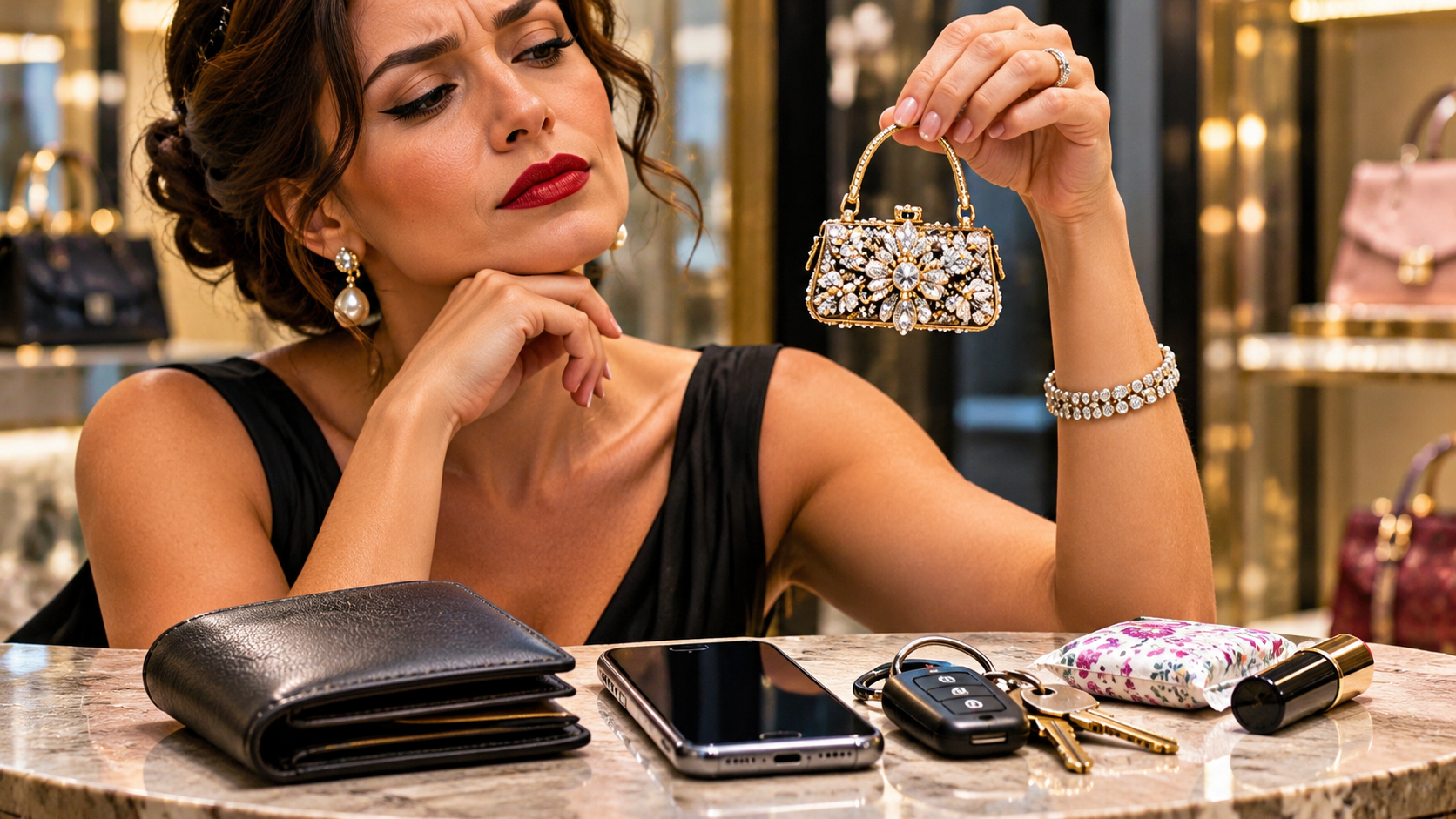
NEW YORK — The luxury fashion industry's renewed enthusiasm for miniature handbags has raised questions about the systematic exclusion of wallets, car keys, mobile phones, and other personal possessions traditionally entitled to transportation inside a purse.
As designers introduce increasingly elaborate accessories with increasingly limited storage capacity, consumers are being forced to reconsider which of their belongings deserve to accompany them into public. The result is an emerging hierarchy in which an object's eligibility for transportation depends less on its importance than on its dimensions.
A November 8 report in the South China Morning Post documents the resurgence of ornate miniature evening bags, including designs associated with Chanel, Dior, Chloé, and Celine. These accessories, sometimes called minaudières, emphasize craftsmanship, decorative materials, and distinctive shapes over conventional storage.
The fashion industry has celebrated their artistic merit without adequately addressing the possessions that can no longer fit inside them.
Personal Belongings Face Increasing Exclusion
For generations, handbags have provided transportation and temporary accommodation for items unable to travel independently with their owners. Wallets, keys, phones, tissues, and emergency breath mints have relied upon these arrangements, often sharing limited interior space despite considerable differences in size, shape, and importance.
The miniature handbag threatens this longstanding system of cooperation. As PurseBlog observed in its examination of the trend, many micro bags cannot accommodate a standard smartphone, leaving owners to carry their phones separately or find alternative storage.
A lipstick may qualify for transportation simply because it occupies less space. A mobile phone, despite providing emergency communication, navigation, and access to financial accounts, may be excluded because its manufacturer failed to anticipate the dimensions of a designer handbag.
The owner is then expected to carry the rejected phone by hand, effectively becoming an unpaid transportation service for an accessory that was purchased to provide transportation services in the first place.
The Problem of Selective Accommodation
Luxury designers have long treated handbags as expressions of personal style, and miniature versions can legitimately function as decorative accessories. Nevertheless, the decision to market an object as a handbag creates reasonable expectations concerning its relationship with the things people wish to carry.
A consumer purchasing a miniature purse may discover that it accommodates a credit card but not the wallet containing that card. Keys may fit individually but become ineligible when attached to a key ring. A folded tissue might be admitted while an unopened packet is denied entry.
Even belongings that meet the size requirements can encounter difficulties when attempting to enter together. A handbag may accommodate a telephone, identification, and a house key during separate demonstrations while proving incapable of transporting all three simultaneously.
Such arrangements place consumers in the position of choosing between their ability to communicate, their ability to identify themselves, and their ability to return home. The industry has yet to establish a standardized method for resolving these competing priorities.
A Minimum Storage Accommodation Standard
A reasonable response would be the establishment of a Minimum Storage Accommodation Standard for accessories marketed as handbags. Manufacturers could continue producing miniature designs but would be expected to disclose which categories of belongings can reasonably expect admission.
A standardized capacity assessment would consider whether a bag accommodates a smartphone, identification, payment method, house key, and one emergency item selected by the owner. Crucially, all five items would have to fit at the same time. Demonstrating that a handbag can accommodate each item individually would not constitute proof of collective accessibility.
Additional provisions could address irregularly shaped possessions, including sunglasses cases, prescription bottles, and the collection of receipts that accumulates in nearly every purse despite repeated efforts to remove it.
Accessibility would also be considered. A handbag requiring its owner to remove four possessions to retrieve a fifth would be classified as providing conditional access rather than full accommodation. Bags requiring tweezers to retrieve a credit card could face additional scrutiny.
Products unable to meet the standard would not be prohibited. They would simply be classified as decorative carrying accessories rather than full-service handbags, allowing consumers to make informed decisions before discovering that their new purchase cannot accommodate the keys needed to leave the store.
The Industry Already Knows How to Make Larger Bags
The enthusiasm for miniature accessories is particularly notable because the same fashion industry has simultaneously embraced oversized handbags. An August report in Vogue Arabia documented the resurgence of roomy totes and carryalls designed to accommodate the practical demands of daily life.
The coexistence of these trends establishes that fashion houses possess both the technical expertise and manufacturing resources necessary to produce adequate storage. The inability of certain handbags to accommodate ordinary possessions cannot therefore be attributed to an industry-wide shortage of available space.
Instead, consumers are presented with two extremes: accessories capable of transporting nearly everything they own and accessories requiring them to leave most of it behind. Between these options lies the modest expectation that a handbag should be able to carry the things its owner brought along.
Belongings Deserve a Place in the Conversation
Consumers remain free to purchase decorative miniature bags, just as designers remain free to create them. The artistic value of a jeweled evening accessory is not diminished by acknowledging that it may be unsuitable for transporting a wallet, phone, and keys.
But celebrating reduced capacity without addressing its consequences risks normalizing the exclusion of possessions that have historically depended upon handbags for safe passage. A wallet should not have to compete with a lipstick for admission, nor should a set of house keys be penalized for remaining attached to a key ring.
A handbag may be a fashion statement. For a wallet, a set of keys, and a phone, it is also public transit.
The fashion industry has spent decades convincing people they need handbags. It now appears determined to convince them they don't need anything inside them.