Frogs Accused of Ghosting Entire Ecosystem for Nearly 50 Years Without Explanation
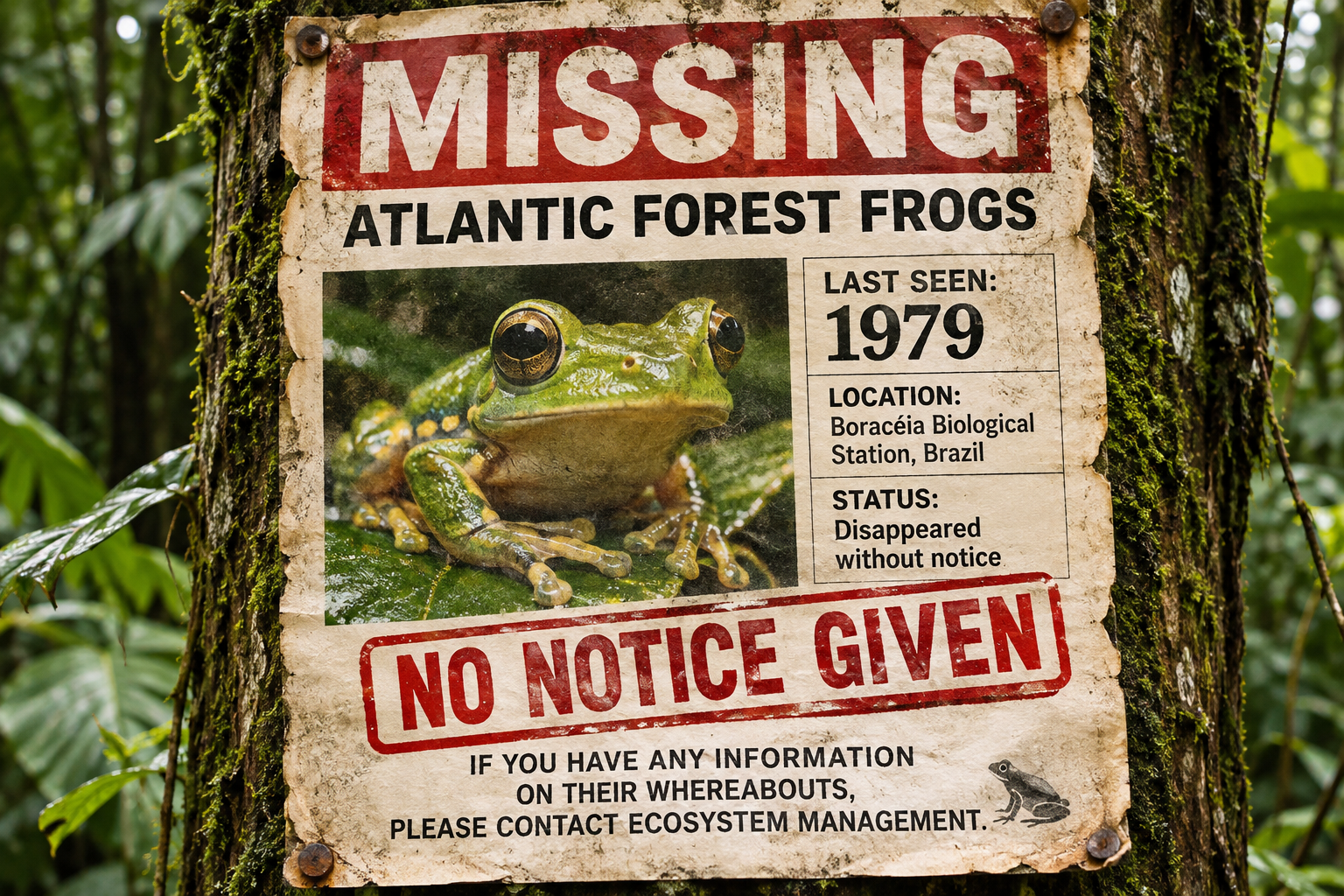
BRAZIL — Nearly half a century ago, frogs at a research site in Brazil’s Atlantic Forest began disappearing in alarming numbers. Scientists spent decades trying to determine what happened. The frogs, meanwhile, offered no explanation, forwarding address or indication of when they might resume their usual duties.
An investigation described in October by the Smithsonian’s National Zoo and Conservation Biology Institute points to a deadly fungal disease as a likely explanation for the historic declines. It is an important scientific finding, although it leaves a separate administrative matter unresolved: nobody appears to have filed an absence report.
A Disappearance Without Proper Notice
The sharp declines occurred around Boracéia Biological Station between 1979 and 1982. For years, researchers considered possible explanations, including environmental changes. The new investigation drew on preserved museum specimens to look for evidence that had been inaccessible when the frogs first vanished.
This is precisely why institutions keep records. Unfortunately, the records in this case seem to have been maintained almost entirely by the people who stayed behind. Frogs are famously vocal when conditions suit them; a male can announce his presence to an entire pond. Yet when a substantial number ceased appearing, not one seems to have left a message with the front desk.
A Fungus, and an Awkward Pattern
Researchers examined more than 370 preserved amphibians from 17 species. They found no detectable evidence of the chytrid fungus in specimens collected before 1979, while more than half of those collected during the 1980s tested positive. The timing strongly supports a role for the pathogen in the declines, though preserved specimens cannot reconstruct every death or establish a single cause for every species.
The details are stranger still. Species that suffered the steepest declines did not show detectable infections in the historical specimens examined, while some species that persisted did. One possible explanation is that the most susceptible frogs died before they could enter museum collections, leaving more tolerant animals behind. The evidence is therefore persuasive without being as simple as “infected frog disappears.”
It also complicates the paperwork. A disease may explain an absence, but it does nothing to improve the quality of the notification. The surviving frogs appear to have negotiated an arrangement with the fungus that their less fortunate neighbors could not. No minutes of those negotiations have surfaced.
The Return, With No Acknowledgment
Surveys conducted at Boracéia between 2022 and 2024 found 12 of the 17 species represented in the historical collection. That is encouraging news for this particular site, not proof that amphibians across the Atlantic Forest have recovered. The other five species were not detected in those surveys, and their local status remains uncertain.
The returning residents have apparently resumed ordinary pond business: eating insects, calling to potential mates and making themselves at home. One can admire the resilience involved while still observing that a person who vanished from the office in 1980 and reappeared in 2024 would be asked to explain the gap on a résumé.
Of course, the frogs owe no one an apology. They were caught in an ecological crisis, and the work of tracing that crisis through old specimens may help scientists understand and protect vulnerable amphibians elsewhere. The Offended recognizes all of this. We simply maintain that a brief courtesy note would have saved everyone considerable confusion.
The Offended has reached no frogs for comment. None have returned our calls.
SATIRE NOTICE: The historical declines, specimen analysis and recent surveys are real scientific findings. The alleged failure of amphibians to observe office etiquette is fictional commentary.