Trump's Oval Office Proclamation Raises Concerns Over Lack of Geometric Diversity
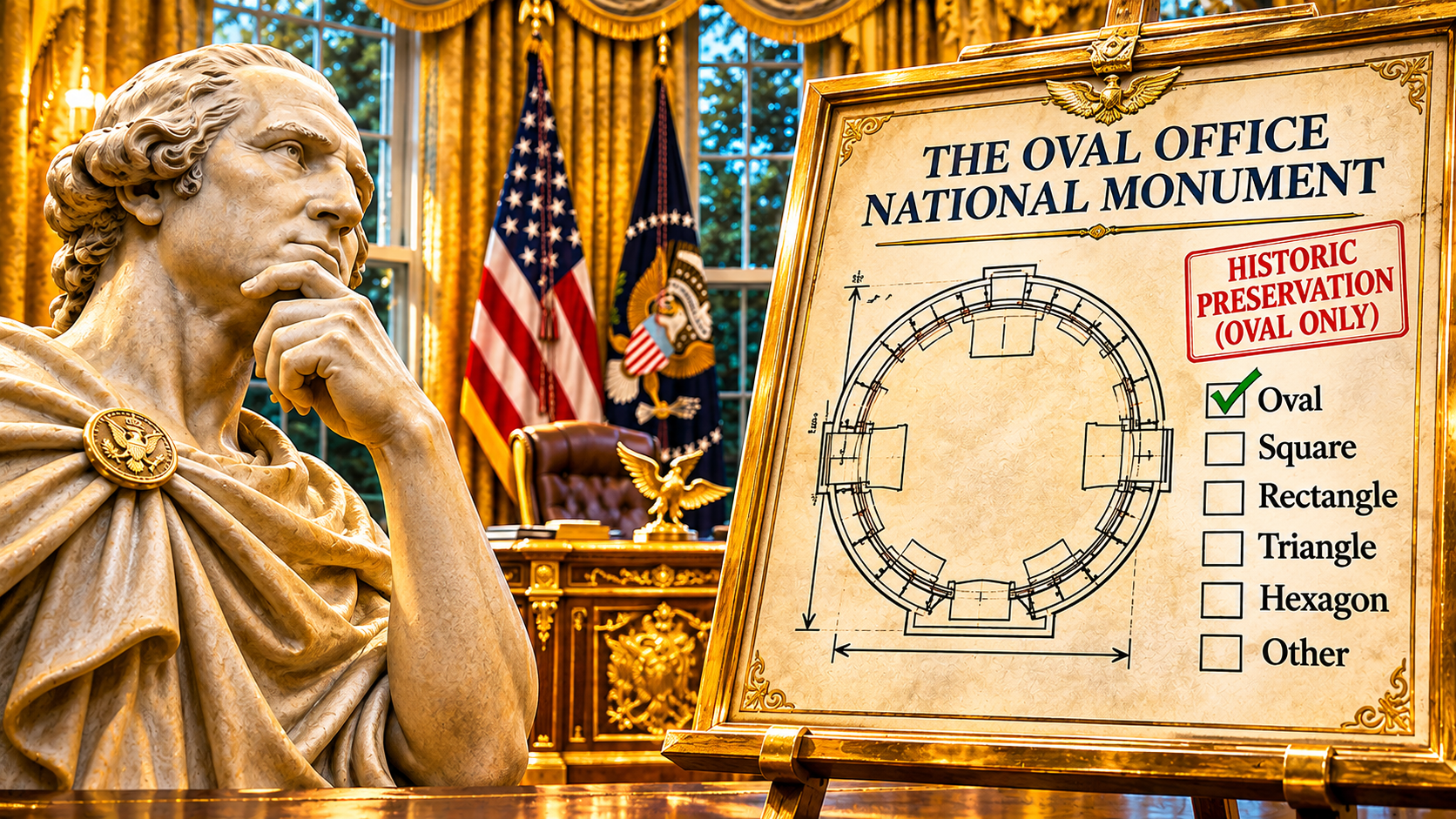
WASHINGTON, D.C. — President Donald Trump's decision to designate the Oval Office as a national monument has renewed debate over historic preservation, presidential authority, and the administration's extensive White House renovations. Signed November 5, just two days after the midterm elections, the proclamation seeks to protect the historic character of the nation's most recognizable presidential workspace. Yet it leaves a more fundamental question unanswered: Why has the federal government formally endorsed one geometric identity without determining whether the room itself identifies with it?
The presidential proclamation establishes the Oval Office National Monument under the Antiquities Act, encompassing the Oval Office, Outer Oval Office, and Cabinet Room. It directs the Interior Department, through the National Park Service, to develop preservation procedures and review proposals that would substantially alter the protected spaces.
The announcement comes amid criticism of Trump's own architectural changes, including the demolition of the White House's East Wing to accommodate a new ballroom. As Reuters reported, the president has also introduced extensive gold accents and other decorative changes to the Oval Office. Questions about the consistency of his preservation priorities have consequently dominated the discussion, overshadowing the proclamation's repeated and unquestioned reliance on the word "oval."
A Geometric Identity Assigned Without Consultation
The proclamation repeatedly identifies the presidential workspace as the "Oval Office," treating its architectural configuration as a defining characteristic rather than a designation subject to reconsideration. It establishes no procedure for determining whether a federally protected space's assigned geometric classification accurately reflects its preferred identity.
The distinction is important. Architectural appearance and geometric identity are not necessarily interchangeable concepts. A room constructed with curved walls may have been designed to satisfy the aesthetic expectations of a particular historical period, but that design does not establish whether its current spatial identity remains consistent with those expectations.
The federal government has therefore taken the extraordinary step of protecting an architectural classification without first conducting any documented assessment of geometric self-identification. Neither the proclamation nor the accompanying White House fact sheet identifies a consultation process through which the room's preferences were established.
Square Representation Explicitly Discouraged
The administration's position became more apparent during Trump's remarks to reporters. Discussing the possibility of future alterations, the president specifically raised the prospect of converting the Oval Office into a square room, suggesting that Congress should have to approve such a change.
According to Reuters, Trump expressed hope that lawmakers would prevent such a conversion. Although the proclamation itself establishes a review process rather than a new congressional-approval requirement, the president's remarks make clear that square geometry is regarded as an alternative requiring special scrutiny.
This creates a troubling imbalance in geometric representation. Oval architecture receives formal federal recognition and protection, while square configurations are discussed principally as alterations to be resisted. Rectangles, triangles, hexagons, and trapezoids receive no explicit acknowledgment of their potential suitability for executive office space.
Nor does the proclamation establish a mechanism for accommodating alternative geometric preferences. A proposal to introduce right angles into the presidential workspace would be evaluated against the historic character of the existing structure, rather than through a process expressly recognizing the legitimacy of non-oval architectural identities.
The Unrecognized Third Dimension
The designation also raises concerns about dimensional representation. An oval is ordinarily understood as a two-dimensional figure, whereas an office occupies three-dimensional space. By identifying the room primarily through its horizontal outline, the government has effectively elevated one planar characteristic above its height, depth, and volume. The proclamation offers no explanation for this dimensional preference or acknowledgment that the room's complete spatial identity may extend beyond its floor plan.
The issue is not whether the room possesses an oval-shaped footprint. Its architectural history is well established. The question is whether that physical characteristic should be permitted to determine its official identity indefinitely, particularly when the designation carries the authority of the federal government.
Preservation Without Geometric Choice
There are important limits to the proclamation's legal effect. As the Associated Press explains, future presidents retain the ability to redecorate the Oval Office, and a successor could seek to reverse the designation. The proclamation expressly preserves ordinary furnishing and decorating decisions, provided they do not substantially impair the historic structure.
Those protections preserve presidential decorating discretion, but they do not establish a comparable framework for geometric self-determination. Future occupants may select different curtains, furniture, and artwork while the room's fundamental architectural identity continues to be defined by a classification inherited from earlier administrations.
A more inclusive preservation policy could acknowledge that historic architecture and geometric identity are separate considerations. Such recognition would not require immediate reconstruction, the removal of historic features, or even a change to the room's familiar name. It would merely establish that an inherited geometric designation need not be treated as conclusive evidence of a space's preferred form.
For now, the federal government has committed itself to protecting the Oval Office's historic character while leaving unresolved the question of whose geometric expectations that character represents. The president has made clear that he wants the Oval Office to remain oval. What remains unclear is whether anyone has bothered to ask the office.