Dave Chappelle Controversy Raises Questions About Public's Right to Remain Uninformed
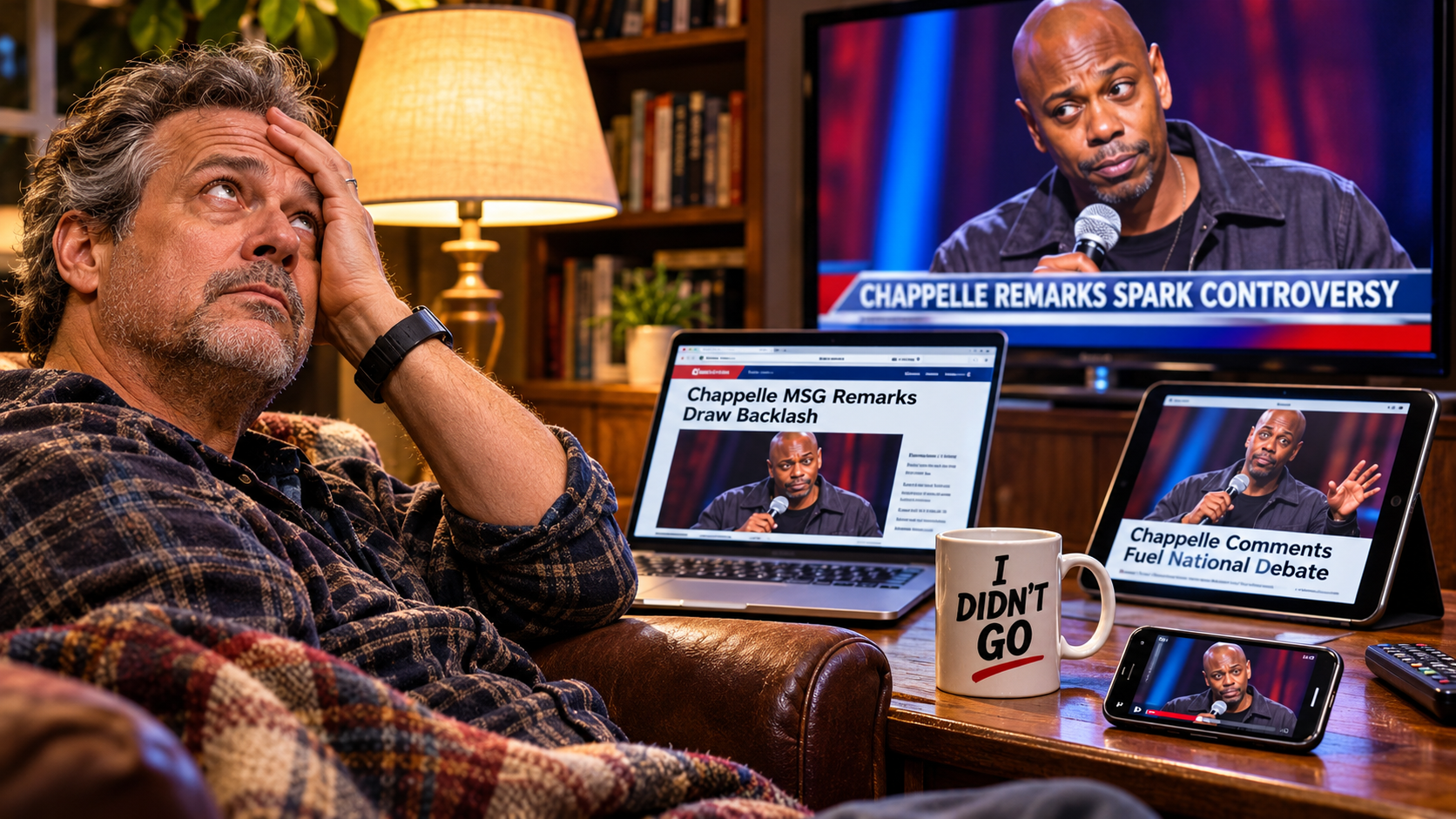
NEW YORK — The circulation of unauthorized footage from Dave Chappelle's November 7 performance at Madison Square Garden has raised serious questions about the public's ability to remain unaware of events it deliberately chose not to attend.
The comedian's remarks concerning the assassination of conservative activist Charlie Kirk have generated widespread criticism, with public figures debating the boundaries of acceptable comedy. But amid the controversy, comparatively little attention has been paid to the millions of Americans who successfully avoided purchasing tickets to the performance, only to discover that the material had followed them home.
The event was explicitly advertised as a device-free experience. According to Madison Square Garden's published event policy, audience members were prohibited from using phones, cameras, tablets, smartwatches, and other recording equipment during the show.
Nevertheless, footage escaped into the public domain, exposing countless non-attendees to information they had taken reasonable steps to avoid by remaining elsewhere.
A Carefully Constructed Barrier Fails
Chappelle's performances have long employed restrictions intended to prevent unauthorized recording and encourage audiences to experience the material in person. At Madison Square Garden, attendees were required to secure electronic devices in special Yondr pouches, retaining physical possession of their phones while surrendering the ability to use them inside the performance space.
The arrangement established a clear boundary between those who had paid to hear the comedian and those who had not. Thousands of devices were restricted to preserve that boundary, yet at least one recording reached the outside world.
As the Los Angeles Times reported on November 8, Chappelle's remarks became the subject of widespread criticism after footage circulated despite the restrictions.
The circumstances under which the recording was obtained remain unclear. What is apparent is that a system requiring thousands of audience members to secure their devices failed to prevent millions of people outside the venue from learning what happened inside it.
The Forgotten Rights of Non-Attendees
An individual who purchases a ticket to a comedy performance voluntarily accepts the possibility of encountering jokes, controversial remarks, and material that may provoke disagreement. Someone who remains at home makes no such commitment.
Millions of Americans spent Saturday evening watching television, preparing dinner, completing household chores, or engaging in activities that did not involve Dave Chappelle. Their decision not to attend should have provided a reasonable degree of protection from learning what was said there.
Instead, the recording entered social media feeds, news reports, and online discussions. People attempting to check sports scores, weather forecasts, or grocery prices suddenly faced the possibility of acquiring an unsolicited opinion about a comedy performance.
For some, the exposure may have been particularly disruptive. Individuals who had successfully avoided Chappelle's comedy for years could find that record of nonparticipation overturned by a single headline. Others who had never heard of the controversy were introduced to it through articles explaining why they should be concerned.
The ability to decline attendance has traditionally been understood as sufficient protection against experiencing a live performance. The events of November 7 suggest that physical absence no longer guarantees informational absence.
A Failure of Information Containment
Madison Square Garden's device restrictions were extensive, covering conventional cameras and mobile phones as well as smartwatches and other recording equipment. The policy was intended to prevent unauthorized documentation, not merely discourage it.
Yet the eventual circulation of footage transformed a localized entertainment event into a national discussion. A performance that thousands of ticket holders were prohibited from recording became available for examination by people who had never agreed to participate.
The failure raises a question of proportionality. If thousands of devices must be confined to prevent unauthorized recording, what protections should be afforded to millions of citizens who never entered the building?
Existing policies place the burden of compliance almost entirely upon the audience. They offer comparatively little protection to the broader public, whose members may encounter the resulting material without warning, preparation, or even a passing interest in stand-up comedy.
The entertainment industry has developed sophisticated methods for controlling what leaves a performance venue. It has devoted considerably less attention to protecting people who would prefer that nothing arrive.
Establishing a Right Not to Know
A reasonable response would be the development of a Voluntary Public Unawareness Standard for performances subject to recording restrictions. Under such a framework, members of the public who did not purchase tickets would be presumed to have declined participation in both the event and any subsequent controversy arising from it.
Social media platforms could implement an Unsolicited Comedy Exposure Warning, notifying users before displaying footage or descriptions of jokes from performances they did not attend. The warning would permit individuals to remain uninformed without requiring them to learn the substance of the controversy first.
News organizations could adopt similar procedures, ensuring that headlines do not inadvertently disclose the very information readers might wish to avoid. Articles concerning controversial performances could begin with a neutral advisory that something was said by someone, somewhere, without immediately identifying the parties involved.
A more comprehensive system might allow citizens to register entertainers, sporting events, award ceremonies, and celebrity disputes about which they wish to remain uninformed. Such preferences could be honored across participating platforms, reducing the likelihood that someone seeking a weather forecast would unexpectedly acquire knowledge of a comedian's weekend activities.
Participation would remain voluntary. Anyone actively searching for Chappelle's remarks could continue doing so, while those who had made no effort to discover them would receive the same consideration afforded to audiences who paid to attend a phone-free performance.
The Burden of Knowing
The controversy surrounding Chappelle's performance has generated debate about comedy, political violence, and the responsibilities of public figures. Those discussions remain available to anyone wishing to participate, and the public's ability to examine controversial statements is not in question.
What remains unresolved is whether people who deliberately avoided an event should be expected to absorb its aftermath simply because someone managed to record it.
Madison Square Garden's restrictions demonstrated that the entertainment industry already recognizes the value of controlling access to certain performances. Extending consideration to those outside the venue would acknowledge that non-attendance is also a meaningful choice, one deserving of protection from unsolicited cultural participation.
Thousands of people paid to hear Dave Chappelle speak. Millions of others paid nothing, made no reservations, and stayed home.
They had every reason to expect they wouldn't have to hear him at all.